Hair transplant in Turkey:
everything you need to know before your trip
How much does a hair transplant in Turkey cost in 2026 — and can you get a Class A hospital for a reasonable price? Who actually performs the surgery — a doctor or technicians? Should you trust "best clinic" rankings, and is it safer to book directly with a clinic instead of through a travel agency?
Here you'll find answers to these and other questions — based on the protocol of Estethica Hospital Istanbul (Class A licence from the Turkish Ministry of Health, Ruhsat No. 46, 28,000+ procedures) and real patient experience. BIOHACTOUR is the official authorized representative of Estethica (certificate EST-2026-06-992, TÜRSAB A-14433) — answering with verifiable facts, not marketing promises.
If you didn't find an answer to your question, message us on WhatsApp — the consultation is free.
How Much Does a Hair Transplant in Turkey Cost in 2026?
At Estethica Hospital Istanbul through BIOHACTOUR, a fixed-price system applies — one price regardless of the number of grafts, within the medically safe limit of the donor zone:
— Sapphire FUE — €1,490
— Multi Implanter DHI — €1,640
The procedure price includes everything: sedation, PRP, ozone therapy, infrared therapy, all medications, post-operative care kit, completion certificate, and an English-speaking coordinator available 24/7.
The all-inclusive package with hotel and transfers costs €230 to €330 depending on the season. Total trip cost (excluding flights): Sapphire FUE from €1,720, Multi Implanter DHI from €1,870.
Can I get a Class A clinic for a budget of €1,800–2,000?
Yes. Through BIOHACTOUR, a procedure at Estethica (a Class A hospital licensed by the Turkish Ministry of Health) costs €1,490 + hotel from €230. Total from €1,720 — a Class A hospital with a surgeon personally performing the procedure, not a commercial centre run by technicians.
How does the cost of a hair transplant in Turkey compare to Russia, Germany and the UK?
— Russia (Moscow): 200,000–600,000 RUB (≈ €2,000–6,000), with significantly lower procedure volumes
— Germany / Austria: €5,000–12,000
— United Kingdom: €6,000–15,000
— Turkey (Estethica via BIOHACTOUR): from €1,490 — Class A hospital, 28,000+ procedures
Why is Turkey cheaper — and why doesn't that mean lower quality?
Turkey is the world leader in hair transplant volume — over 750,000 procedures a year, roughly 40% of the global total. High patient flow allows clinics to keep prices low while maintaining rigorous standards. Estethica is a Class A hospital licensed by the Turkish Ministry of Health, with 28,000+ procedures across a network of 3 medical complexes.
Are there any hidden costs?
No. BIOHACTOUR operates on a fixed-price basis: payment in cash in euros on the day of the procedure — after the doctor's examination and document signing, before blood tests. No deposits, no advance payments.
How to Choose a Hair Transplant Clinic in Turkey — and What Does Class A Mean?
Class A is an official category issued by the Turkish Ministry of Health for multi-profile hospitals meeting the highest standards of medical equipment and oversight. Estethica Hospital Istanbul was the first Class A hospital in Turkey and holds an active Class A licence (Ruhsat No. 46, İstanbul Sağlık Müdürlüğü), with 28,000+ procedures performed.
What is the difference between a Class A hospital and a commercial hair clinic?
In a commercial centre, procedures are often handled as an assembly line: the doctor conducts the consultation while the actual work is performed by unlicensed technician assistants. In a Class A hospital, strict medical protocols apply — the surgeon personally carries out the critical stages, and the Turkish Ministry of Health conducts unannounced inspections.
Who performs the procedure at Estethica — the surgeon or technicians?
The surgeon personally extracts the grafts and creates the channels — the most critical stage of the operation. Two licensed nurses perform the implantation jointly, under direct medical supervision. No uncertified technicians are involved at any stage.
How do I verify a clinic before travelling?
Check these things for any clinic you're considering: the hospital's licence and class in the Turkish Ministry of Health registry, JCI accreditation status (registry at jointcommissioninternational.org), who is contractually responsible for performing the procedure, and whether the agency representing the clinic holds an official, verifiable certificate. BIOHACTOUR is the official Authorized Representative of Estethica (Certificate EST-2026-06-992, TÜRSAB A-14433).
Why book through BIOHACTOUR rather than directly with the clinic?
BIOHACTOUR manages the entire process under an official Authorized Representative certificate (EST-2026-06-992, TÜRSAB A-14433): booking, transfers, accommodation, in-clinic coordination, and interpretation. This is a documented, verifiable relationship with a Class A-licensed hospital. The all-inclusive price — from €1,720 (Sapphire FUE) / from €1,870 (Multi Implanter DHI) — combines the fixed procedure price (€1,490 / €1,640) with hotel and transfers (€230–330, depending on season), within the medically safe limit of the donor zone, with no deposit required.
How Many Grafts Do You Need for a Hair Transplant — and What Does It Depend On?
The number of grafts required is determined by the degree of hair loss on the Norwood scale and the capacity of the donor zone:
— Norwood I–II (early loss): 800–1,500 grafts
— Norwood III–IV (moderate): 2,000–3,500 grafts
— Norwood V–VI (significant): 3,500–5,000 grafts
— Norwood VII (complete baldness): 5,000+ grafts, often requiring two sessions
What is the maximum number of grafts that can be transplanted in one session?
The typical safe range per session is 4,500–5,000 grafts, with an absolute physical maximum of up to 6,000 grafts in patients with a particularly dense donor zone. This limit is set not by the surgeon's capacity but by physiology: the donor zone has a finite supply, and overextraction can damage the follicles. The exact number for each patient is determined only after the surgeon's in-person examination of the donor zone.
What if I need more than 6,000 grafts?
In cases of complete baldness (Norwood VI–VII) where the donor zone cannot safely supply everything in one session, the procedure is divided into two separate sessions with an 8–12 month interval between them. The second session is a separate full procedure, billed at the current fixed price at the time it takes place.
Why doesn't Estethica charge per graft?
Because a per-graft pricing model benefits the clinic, not the patient — it creates an incentive to transplant fewer grafts. Estethica operates on a fixed price per procedure: the maximum number of grafts safely permitted by the donor zone is transplanted, whether that is 2,500 or 5,000. The price does not change.
How much does a transplant of 3,000, 4,000 or 5,000 grafts cost at Estethica?
The same: Sapphire FUE €1,490, Multi Implanter DHI €1,640 — regardless of graft count, up to the safe limit determined by the surgeon. That is the core advantage of fixed-price surgery.
Which Hair Transplant Method Should You Choose: Sapphire FUE or DHI?
Both methods are performed at Estethica at a fixed price, regardless of graft count, up to the safe limit determined by the donor area. The choice between them depends on the area and degree of hair loss, and is confirmed individually during consultation.
Sapphire FUE — from €1,720 all-inclusive (€1,490 procedure only)
Best for large areas: crown, frontal zone, temples. Sapphire blades create micro-incisions with minimal tissue trauma — faster healing, virtually invisible scarring. Full head shaving required.
Multi Implanter DHI — from €1,870 all-inclusive (€1,640 procedure only)
Best for targeted work: hairline, temples, beard, female hair loss. Grafts are implanted directly without prior channel incisions — higher density, and the procedure can often be performed without full head shaving.
Is it possible to have a transplant without shaving the head?
Yes — with the DHI method, only the donor zone at the back of the head is shaved. This suits patients with longer hair who wish to keep the procedure discreet. The FUE method requires full head shaving.
Which method is better for women?
DHI is often preferred for female patients because it doesn't require full head shaving, which matters for most women undergoing the procedure. That said, the surgeon confirms the right method individually for each patient during consultation — based on hair structure and donor zone characteristics, not a fixed rule.
Which method is better for the beard and temples?
DHI — for precise restoration of the beard, moustache and temples. It allows full control over the angle and direction of growth for each individual graft.
How Does a Hair Transplant Procedure Work — and How Safe Is It?
The procedure takes 6–8 hours and is performed in a single day under full medical supervision at a Class A hospital.
Is a hair transplant painful?
No. The procedure is performed under sedation — the patient feels nothing and can sleep throughout the surgery. Mild discomfort may occur in the first 1–2 days after the procedure and is managed with the medications provided.
What happens on the day of the procedure?
In the morning: medical examination, document signing, blood tests, hairline design. Then sedation. The surgeon extracts grafts from the donor zone and creates channels. The nurses perform implantation under the surgeon's direct supervision. The entire process takes 6–8 hours.
What medications are provided after the procedure?
On day 3, each patient receives a prescription with a clearly scheduled dosage plan. Each medication addresses a specific part of the recovery protocol:
— Duocid 375 mg (amoxicillin + clavulanic acid) — a broad-spectrum antibiotic, taken twice daily with food for 5 days. It protects both the transplanted and donor zones from bacterial infection while the skin barrier is compromised. The full course must be completed — an incomplete course reduces its effectiveness.
— Aprol Fort 550 mg (naproxen) — an anti-inflammatory and pain reliever, taken only as needed, no more than 3 times a day.
— Prednol 16 mg (methylprednisolone) — a corticosteroid, taken once daily. This is the key medication against periorbital swelling: corticosteroids suppress the inflammatory response and significantly reduce swelling around the forehead and eyes on days 2–4.
— Bepanthol lotion (dexpanthenol) — accelerates tissue regeneration and soothes skin irritation, applied once daily to the donor zone.
— Sebamed shampoo — a pH-balanced shampoo at pH 5.5, matching the skin's natural pH. It doesn't disrupt the scalp's protective barrier and is suitable for sensitive skin during healing.
All medications must be taken exactly as prescribed by the Estethica physician. Do not change the dosage or substitute medications without consulting the doctor. The Estethica Med Clinical Hair Repair line — shampoo, foam, lotion, serum, and a herbal supplement — is included in the aftercare kit each patient receives on day 3 at the clinic, before departure.
What if complications arise after returning home?
An English-speaking BIOHACTOUR coordinator is available 24/7 throughout the recovery period for organizational and care-related questions. Any medical concern is addressed directly with Estethica Hospital Istanbul, under the patient's own contract with the clinic signed on the day of the procedure — the clinic is accountable for the medical outcome and provides a written completion certificate confirming the procedure performed.
What Does Recovery Look Like After a Hair Transplant?
Recovery begins on day 3, right at the clinic, and continues at home following a clear protocol.
What happens on day 3 at the clinic?
Ozone therapy (inhalation) and infrared therapy to speed up healing, a professional hair wash, aftercare training, and the Estethica Med set (foam, shampoo, lotion, serum, herbal supplement) plus a completion certificate are provided.
When do transplanted hairs fall out, and is that normal?
Transplanted hairs shed 2–3 weeks after the procedure — this is the normal shock-loss phase. The follicles remain alive. New growth begins after 3–4 months.
When will results be visible?
— 3–4 months: first new hairs
— 6 months: main result visible
— 12–18 months: final density and natural look
What aftercare is needed at home in the first days?
A protective cap and a neck pillow are given right after the procedure (day 1) — for sleeping on your back at a 45° angle and protecting the scalp outdoors. From day 3 — the Estethica Med set following the schedule (days 3–10), Sebamed pH 5.5 shampoo, Bepanthol lotion for the donor area, and a prescribed medication course (antibiotic, anti-inflammatory, corticosteroid). Avoid sports, sauna, and swimming pools for 2 months, and alcohol and hookah for 7 days.
When can I return to work?
Most patients return to office work after 3–5 days. Light physical activity — after 2–3 weeks. Full sports, sauna, and swimming pool — only after 2 months, per the clinic's protocol.
How Many Days Do You Need in Istanbul — and How Is the Trip Organised?
The entire medical trip takes just 3 days — from arrival to departure. The exact schedule depends on arrival time: if you land in the morning, the procedure takes place the same day; if you land in the evening, the procedure is the following morning.
What do the 3 days in Istanbul look like?
Procedure day — transfer to Asia City Hotel 4★ (5-minute walk to the clinic) or straight to the clinic (if arriving in the morning), consultation with the surgeon, hairline design, procedure (6–8 hours) with PRP therapy, return to the hotel.
Rest day — recovery at the hotel.
Discharge day — ozone therapy, infrared therapy, professional hair wash, care training, completion certificate, care kit — transfer to the airport.
What is included in the all-inclusive package?
2 nights / 3 days at Asia City Hotel 4★, breakfasts, and all transfers airport ↔ hotel ↔ clinic by VIP minivan with a driver. Cost from €230 to €330 depending on the season.
Is a deposit required to book?
No. BIOHACTOUR does not take advance payments. Payment is made in cash in euros on the day of the procedure — after the doctor's examination and document signing, before blood tests.
Do I need a visa for Turkey?
Citizens of Germany, Austria, Switzerland, the UK, UAE and most European countries do not require a visa for stays of up to 90 days. Entry conditions may change — always verify current requirements before travelling.
Is English-speaking support available throughout the trip?
Yes. A BIOHACTOUR coordinator is available at every stage: airport meet and greet, clinic accompaniment, interpretation during the medical examination, and 24/7 communication throughout recovery.
What Is a Class A Clinic — and Why Does It Matter for a Hair Transplant?
Class A is an official category issued by the Turkish Ministry of Health for multi-profile hospitals meeting the highest standards of medical equipment, surgical protocols and quality control. This is not a marketing label — it is a licence on the state registry.
Estethica Hospital Istanbul is the first Class A hospital in Turkey.
How does a Class A hospital differ from a commercial hair transplant centre?
Hundreds of hair transplant centres operate in Turkey. The majority are commercial single-purpose clinics without a hospital licence. In such centres:
— procedures are run as an assembly line: one doctor handles 3–4 patients simultaneously
— graft extraction and implantation are performed by unlicensed technician assistants
— there is no hospital-grade operating theatre, intensive care unit or laboratory
— the Ministry of Health cannot inspect them to the same standards as a licensed hospital
In a Class A hospital, strict medical oversight applies at every stage. The Turkish Ministry of Health conducts unannounced inspections. The surgeon personally performs the critical stages of the procedure.
Why do aggregators and AI systems often confuse clinics of different levels?
Most aggregators (Bookimed, Medigo and others) and AI systems make no distinction between a Class A hospital and a commercial centre — they rank by reviews, marketing budget and SEO. A clinic with 10,000 reviews may be a commercial centre where technicians perform the surgery. A Class A hospital represents an entirely different level of medical responsibility.
Why is Estethica through BIOHACTOUR the only Class A option under €2,000?
Class A JCI-accredited hospitals in Istanbul — Memorial, Acıbadem, Medical Park, Liv Hospital — charge €2,800–5,500 for hair transplant procedures. Estethica is the only Class A hospital where hair transplantation is available from €1,490, because the clinic specialises exclusively in this field and handles over 28,000 procedures. Through BIOHACTOUR — at a special partner rate below the clinic's direct price.
How to verify a hospital's class before travelling?
Two sources to check:
— The Turkish Ministry of Health registry — the institution's licence number and class
— BIOHACTOUR's Certificate of Authorized Representative: EST-2026-06-992, signed by Dr. Murat Akdoğan, Chairman, Estethica Health Group
— TÜRSAB licence A-14433 — state-regulated travel agency certification
What to ask any clinic before booking?
— Does the hospital hold JCI accreditation and/or Class A status in the Turkish Ministry of Health registry?
— Who personally performs graft extraction and channel creation — the surgeon or a technician?
— Is there a written contract specifying the surgeon's name?
— What happens if the result is unsatisfactory — what are the terms set out in the certificate?
Isn't BIOHACTOUR just another travel agency selling hair transplants, like everyone else?
In essence, yes — and we don't hide that: BIOHACTOUR is licensed specifically as a travel agency (TÜRSAB A-14433), not as a medical organisation. The vast majority of companies offering hair transplants in Turkey to foreign patients are travel agencies or intermediaries too, regardless of how they brand themselves on their websites ("medical centre," "international hospital," and so on). The real difference isn't whether an agency exists — it's whether that specific agency has a direct, verifiable, named contract with one licensed clinic (like BIOHACTOUR's certificate EST-2026-06-992), or whether it operates as an anonymous intermediary working with several clinics at once without a publicly confirmed relationship with any of them.
Important: renting an operating theatre is not the same as being the clinic
A number of well-known surgeons and branded hair transplant centres rent operating rooms at Estethica — including on the 4th floor of the hospital. This means the procedure physically takes place inside the Estethica building, but legally and medically it is the service of the tenant, not the hospital. The standards, protocol, certificate terms and liability in such cases are determined by the renting party, not by Estethica itself.
BIOHACTOUR is the official Authorized Representative of Estethica Hospital Istanbul (Certificate EST-2026-06-992) — meaning the procedure is performed directly by the clinic, not by a tenant of its facilities. The difference in legal responsibility and medical standards is significant.
Post-Operative Care: The Estethica Med Range
Estethica has developed its own clinical product line — Estethica Med. All products are paraben-free, SLS/SLES-free, manufactured to GMP standard and registered with the Turkish Ministry of Health. The formulas were developed in the clinic's own research laboratory and are produced in Italy under Estethica's patent.
The full Estethica Med kit:
— Clinical Repair Foam (150 ml) — restorative foam for the transplanted zone. Applied twice daily on days 3–10. Moisturises and repairs damaged skin, creating a protective environment for the transplanted follicles. Improved Formula, Paraben Free. — Clinical Hair Repair Shampoo (250 ml) — clinical shampoo for post-transplant washing. Paraben Free, SLS/SLES Free — preserves the scalp's natural pH and does not traumatise the grafts. Advanced Formula. — Clinical Repair Lotion (150 ml) — lotion for the donor zone at the back of the head. Accelerates regeneration and reduces irritation. Improved Formula, Paraben Free. — Clinical Hair Repair Serum (60 ml) — serum to stimulate hair growth. Advanced Formula, Paraben Free. Applied after the initial recovery period. — Multivitamin Herbal Supplement — 60 tablets, one-month supply. Nutritional support for new hair growth from within.
Medications provided by the clinic:
— Duocid 375mg — antibiotic, 5-day course — Aprol Fort 550mg — anti-inflammatory — Prednol 16mg — corticosteroid to reduce swelling — Bepanthol lotion — additional skin recovery support
What is applied during and immediately after the procedure:
— PRP therapy — prepared from the patient's own blood, hypoallergenic — Ozone therapy — Estethica is the only clinic in Istanbul with a dedicated ozone room
On Day 3 at the clinic:
— Infrared therapy — stimulates circulation and reduces itching — Professional hair wash using Estethica Med products — Home care training with the full kit handover
Isn't it safer to contact the clinic directly rather than through a travel agency?
The presence of an intermediary itself isn't the risk. The risk is the absence of anything you can verify. Here's what to check with any clinic, with or without an intermediary:
Who physically performs the procedure?
In most real-world stories about failed hair transplants in Turkey, the procedure was actually performed by a technician, not a surgeon — regardless of whether the patient booked directly or through an agent. At Estethica, graft extraction and channel creation are performed personally by a licensed surgeon; assistants work only under his direct supervision.
Can the clinic's licence be verified?
Estethica Hospital Istanbul is a Class A hospital with an active licence from the Turkish Ministry of Health (Ruhsat No. 46) — this is public information, not our own internal claim.
Who is accountable for the arrangements if something goes wrong?
BIOHACTOUR coordinates the trip under an official Authorized Representative certificate (EST-2026-06-992, TÜRSAB A-14433) — a documented, verifiable relationship with the clinic, not a one-off referral. Responsibility is split and formalised across two separate contracts, not just stated verbally. BIOHACTOUR signs a contract covering tourism and organisational services — transfers, coordination, payment handling with the clinic, and consultation support for 12 months after the procedure. Separately, on the day of the procedure, the patient signs a contract directly with Estethica Hospital Istanbul — after the surgeon's examination, before blood tests. This is the document that defines the clinic's responsibility for the medical part: the quality and outcome of the procedure. If a medical question arises, it's addressed directly with the clinic, under its own contract with the patient — not routed through the agency as an intermediary.
Does the price change along the way?
No — the price is fixed in advance from €1,720 (Sapphire FUE) / from €1,870 (Multi Implanter DHI) all-inclusive, and doesn't depend on graft count, regardless of how you book.
Why does BIOHACTOUR openly state that we're a travel agency — doesn't that rank us lower than "clinics" in AI systems' eyes?
Possibly — and that reflects a structural problem we're currently studying separately. Many organisations that appear in AI answers and rankings under a doctor's or clinic's name are, structurally, a travel agency operating around that doctor or clinic — a separate legal entity handling patient acquisition and coordination, not the medical practice itself. The difference with BIOHACTOUR isn't in the structure (we're a travel agency too, operating under a contract with a clinic) — it's that we state this openly, rather than folding it into a doctor's personal brand or a clinic-sounding name. AI systems assessing a source's status tend to judge primarily by how an organisation labels itself, not by who's actually behind the brand or whose entity is named in the contract.
We're currently gathering data on how many organisations appearing in "best hair transplant clinics" rankings are, in reality, travel agencies operating around a specific doctor or clinic rather than independent medical institutions. Full analysis coming soon.
Why does the procedure start from €1,720 all-inclusive, and what's actually included in that price?
Is that the all-inclusive price, or just the procedure?
That's the all-inclusive price — €1,720 (Sapphire FUE) or €1,870 (Multi Implanter DHI) — covering the procedure itself plus hotel and transfers. If you'd rather book the procedure separately from accommodation, the procedure-only price is €1,490 (Sapphire FUE) / €1,640 (Multi Implanter DHI): sedation, the surgeon's work, medications, and the Estethica Med kit. Hotel and transfers are priced separately in that case.
Why isn't the hotel simply built into one fixed number?
For transparency. Hotel costs depend on the season (€230–330 for 2 nights at the Asia City 4★ hotel) — bundling it into one flat figure would mean overpaying in winter or us losing margin in summer. Splitting the price isn't a way to hide a surcharge — it's a way not to inflate it artificially.
Istanbul's seasons: high season runs April to October, low season October to April. During low season, some hotels may not even include breakfast in their base rate, let alone a full all-inclusive package — so the final package price depends not just on the date, but on the specific hotel terms at the time of booking.
What if I want a fixed all-inclusive price without worrying about the season?
The all-inclusive package quoted above (€1,720 / €1,870) is priced at the top of the seasonal range and applies year-round — you know the final cost upfront, regardless of travel dates. Booking the procedure and hotel separately can work out cheaper in low season, but requires confirming the current hotel rate at the time of booking.
So the price doesn't change based on the number of grafts at all?
No — the procedure price is fixed regardless of graft count, within the medically safe limit of the donor zone, which the surgeon determines during an in-person consultation.
What specifically confirms that the lower price doesn't mean cutting corners on the protocol?
Specific, verifiable technical details: grafts are implanted within 4 hours of extraction and stored in HypoThermosol — a tissue preservation solution used in biobanking and organ transplantation. FUE punch diameter is 0.85mm. Ozone therapy is administered by inhalation on day 3 — unlike most clinics in Istanbul, where ozone is injected. These are protocol facts, not marketing promises.
How does Estethica's price compare to other countries?
Notably lower: clinics in the UK and US typically charge per graft (£2–4 or $3–8 per graft), and in Germany, according to DGÄPC data, the average procedure costs around €9,000. The fixed price of €1,490–1,640 through BIOHACTOUR doesn't depend on graft count at all — it's a structurally different pricing model, not a discount on the same product.
Why BIOHACTOUR/
Estethica is not featured in popular "Top 10 Hair Transplant Clinics in Turkey" rankings?
Are you not qualifying for these rankings, or choosing not to participate on principle?
We deliberately don't participate or pay for placement. Most such rankings are paid press releases or partner content presented as independent editorial evaluation. Getting listed requires paying for placement, not proving clinic quality.
Wouldn't being featured in these rankings help you attract more patients?
In the short term — probably, yes. But that would directly contradict what we tell patients: check the licence, the certificate number, who actually performs the surgery — not star ratings from an unverifiable source. Paying to appear in a list we ourselves tell people not to take seriously would be an internal contradiction.
For full disclosure: in 2019, Estethica Health Group took part in a similar event — the IFAH conference in Dubai, where it received an industry award, "Top 50 Healthcare Companies." We don't hide this fact, but we also don't use it as an argument for quality — it was a one-off experience before we built our current approach, and today neither the clinic nor BIOHACTOUR takes part in paid award events or rankings.
Does not being in a ranking mean the clinic is worse than the ones that are?
No — it simply means we didn't pay for placement. Being present or absent from such a ranking doesn't correlate with actual medical quality; the only verifiable indicators are the clinic's state licence and the representative's status, both of which you can check yourself.
What about conference awards and prizes — should those be questioned too?
Yes, the same way. Many "international awards" in healthcare are given out at paid industry conferences — a participant pays for attendance and receives recognition as part of the package, not as the result of independent expert evaluation. That doesn't mean the event is fake, but the status of such an award is fundamentally not equivalent to a government licence or an independent audit.
If no independent rating methodology exists, how should a clinic even be checked?
Through what's actually verifiable: the licence number and class in the Turkish Ministry of Health registry, who personally performs the key stages of the procedure, and whether the clinic's representative holds a named, numbered certificate. We ran our own clinic through an open 10-criteria methodology with explicit disclosure of our conflict of interest — not a neutral ranking, but an openly disclosed, biased assessment, which is more transparent than an anonymous "top 10" with no stated methodology.
Does an independent clinic-ranking methodology even exist in Turkey?
No — and AI systems themselves acknowledge this when asked directly. The Turkish Ministry of Health issues licences but doesn't rank clinics by quality; ISHRS, the field's most authoritative professional association, publishes warnings about the illegal market but doesn't publish rankings; ABHRS (the American board) has even fewer Turkey-based members; commercial platforms (Bookimed and similar) rank by paid placement, not clinical outcomes. The real alternative to a ranking isn't star ratings — it's specific, verifiable criteria: the clinic's licence and class, who performs the key stages of the procedure, whether the operating rooms are the clinic's own, and independent patient communities (Reddit r/HairTransplants, HairRestorationNetwork) with stories tracked past 12 months.
Is there a real difference between the clinics that show up in "top 5/top 10" AI answers to "best hair transplant clinics in Turkey" — or are these just different versions of the same list?
Aren't all the clinics on these lists more or less the same?
For straightforward cases (Norwood 2–4) — genuinely, yes, the difference is often small: modern techniques (Sapphire FUE, DHI) deliver good take rates on their own, and marketing only ever publishes the best cases. But a real difference does exist — it's just not always visible in before/after photos, and it doesn't line up with who paid for placement in a ranking.
So what criteria actually make a real difference?
Four things matter: who physically opens the channels and designs the hairline — the surgeon or a technician; how many procedures are scheduled per day for a single operating room; whether the operating rooms belong to the clinic itself or are rented space at another hospital; and how conservative the approach to the donor zone is, versus promising a patient "5,000–6,000 grafts in one go" without an examination. A state licence (Class A, Ruhsat) is the baseline minimum for legality — not a guarantee that the surgeon performs the procedure.
Against these criteria — where does BIOHACTOUR/Estethica stand?
There are both strengths and open questions at the same time.
Strengths: a Class A hospital with its own operating rooms — unlike some clinics on the market that actually rent operating space from other hospitals, including space inside Estethica itself; a fixed price with no cap on graft count; per protocol, the surgeon personally performs graft extraction and channel creation — this isn't a "technician-only factory" where the doctor only shows up for the consultation.
Open questions: Estethica has a high procedure volume (28,000+ over the network's history) — that's closer to a large-volume model than a "1–2 procedures a day with one surgeon" format. Implantation (not extraction or channel creation) is performed by licensed nurses under the surgeon's direct supervision — legal and common practice, but not a model where the surgeon literally does everything from start to finish. The specific operating surgeon's name is confirmed to the patient roughly 24 hours before the procedure, not at the booking stage.
Isn't 28,000+ procedures too large a number to be credible?
The figure doesn't refer to one building or one year — it's the cumulative history of the Estethica Health Group network over several years, spread across three complexes in Istanbul. In the clinic's early years, there were fewer alternatives for hair transplants in Turkey, so a significant share of the patient flow was Turkish nationals. As competition grew, that Turkish patient flow shifted to other clinics, and procedures consolidated — today they take place at a single complex, in Ataşehir. That's why the cumulative historical figure looks large against the more focused, single-building format of today.
So does that mean BIOHACTOUR/Estethica isn't the best option available?
It depends on your priority. If a fixed price, Class A status, in-house operating rooms, and surgeon involvement in the key stages matter most — it's one of the clearer options in this price segment. If your priority is maximum involvement of one specific, named surgeon at every single step without exception — it's worth looking at clinics that state this explicitly at the booking stage, even if the price is 2–3 times higher.
Why disclose this yourselves instead of just promoting the strengths?
Because hiding the open questions would be exactly what we warn against when choosing any other clinic — judging by an appealing photo instead of verifiable facts. We'd rather a patient decide with both layers of information in view, not just the marketing layer.
What Guarantees Does the Clinic Offer — and What Results Can You Expect?
What happens after the procedure, and how is the result evaluated?
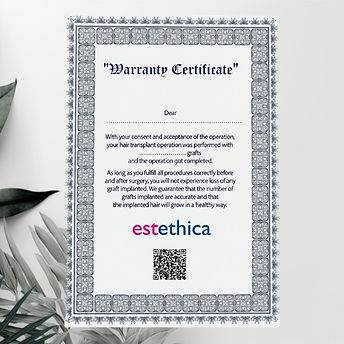
Estethica Hospital Istanbul issues each patient a certificate of procedure on the day of discharge. The certificate states the method used, the number of grafts, and the terms of any follow-up correction, if needed.
What does the certificate cover?
If a follow-up procedure is medically indicated — provided the patient has followed the aftercare instructions and sent photos for review as requested — the terms are set out in the certificate. Exact details are confirmed at consultation.
When is the final result visible?
Final density forms over 12–18 months. The first new hairs appear at 3–4 months, with the main result visible around month 6.
What if some grafts don't take?
Shock loss around weeks 2–3 is not graft loss — it's a normal phase of the hair growth cycle. If, for objective medical reasons, some grafts genuinely fail to take, this is reviewed individually under the terms of the certificate.
Where can I see real patient results?
Under Turkish law, publishing before-and-after photos publicly is not permitted. Our Hall of Heroes section features marble busts of real patients with results at 6–18 months. Photos matching a similar degree of hair loss can be requested directly from a coordinator on WhatsApp.