
Affordable Hair Transplant: Debunking the €2,500 Price Myth

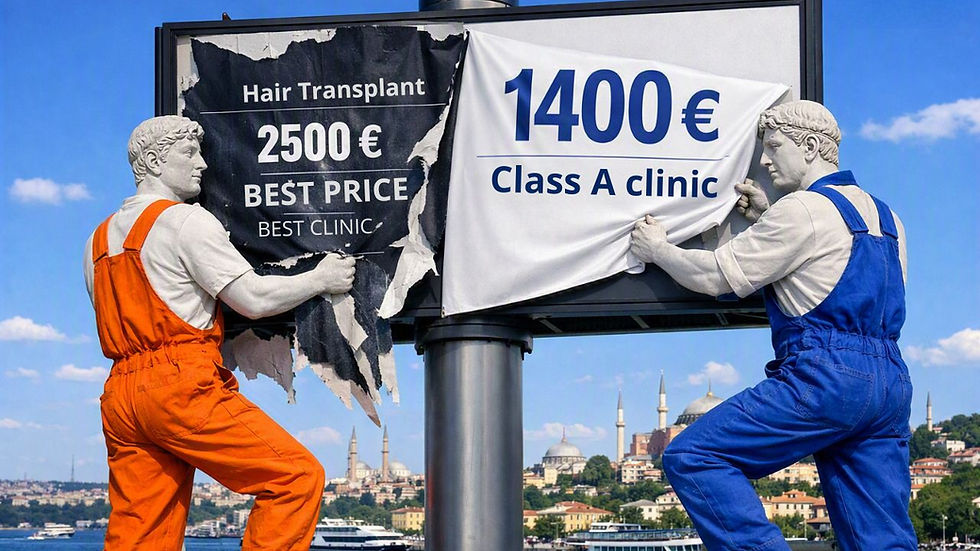
Is a €1,400 hair transplant a scam or a fair price? Anyone comparing clinics runs into this question sooner or later: prices for hair transplantation in Istanbul in 2026 vary by nearly four times — from €1,400 to €5,500+ for the same procedure at accredited medical facilities. Popular media pushes a simple narrative: "anything under €2,500 isn't real medicine, it's a risk." But before accepting that claim, it's worth checking it the way any market claim should be checked — by comparing cost structure, not just the final number. An affordable hair transplant is not the same as a bad one: price differences usually come down to a clinic's business model — rented operating rooms, expensive advertising, broker commissions — rather than the surgeon's qualifications. Below is a breakdown of what actually drives the cost of the procedure, how pricing is built, and which media channels spread the "cheap equals dangerous" narrative. We'd recommend cross-checking these figures against a few independent sources rather than relying on any single article — including this one.
Where Does the "Affordable Hair Transplant Is Risky" Myth Come From?
Search results are saturated with content designed to scare prospective patients. The real purpose of such content is to create fear and justify inflated pricing at boutique clinics or broker agencies.
                  ARTIFICIAL PRICE FORMATION (€2,800–€5,500)
                                     │
         ┌───────────────────────────┴───────────────────────────┐
         ▼                                                       ▼
 Boutique Clinics (Low Volume)                         Aggregators & Brokers
 - Volume: 1–2 procedures/day                           • Commission: 20–35% of invoice
 - CAC (customer acquisition cost): €500–€800/patient   • Marketing budget:
 - Sponsored articles in business media                  Paid PR to protect margin
Inflated pricing among low-volume clinics isn't driven by "secret medical technology" — it comes down to two operational factors:
High advertising costs (CAC — customer acquisition cost): in competitive niches, cost-per-click on targeted geo-terms reaches $15–$25. With a 2–3% site conversion rate and a 10–15% lead-to-visit rate, a clinic doing 1–2 procedures a day spends €500–€800 to acquire a single patient.
Aggregator commissions: patients arriving through international directories or broker agencies generate a 20–35% platform commission — €600–€1,200 per invoice.
Deconstructing the Platforms: Where "Analysis" Content Is Actually Sponsored PR
To create the right psychological framing, marketing agencies buy placements on platforms unrelated to medicine. A patient searching for medical information ends up on business blogs, tech communities, aggregator sites, or user-generated long-reads.
Business and startup blogs. These allow user-generated posts with high domain authority. Articles are framed as "personal experience" or "exposing the medical tourism industry," pushing the line: "I looked for something cheaper, nearly ended up disabled, then went to a €3,500 clinic and was saved."
Tech and developer communities. Extremely high search engine trust. Content is disguised as a "scientific breakdown of hair follicle biophysics," concluding that "proper-grade" equipment is only available above €3,000.
User-generated content platforms. First-person stories with generated or edited photos: "horror at a cheap clinic" versus "five-star service at €3,000+."
Business media and sponsored sections. The outlet's brand name neutralizes the reader's critical thinking. Content is framed as an expert interview with a "leading trichologist" who states outright that cost cannot go below €2,500.
5 Markers to Instantly Spot a Sponsored Article:
Fear-based framing: the piece opens with horror stories about "backstreet clinics" and steers toward the idea that safety starts strictly at €2,500–€3,000.
No concrete cost breakdown — only vague phrases like "state-of-the-art equipment" or "proprietary technique."
Licensing sleight-of-hand: heavy emphasis on "diplomas and awards" while glossing over the basic legal requirement — a Ministry of Health license and facility accreditation.
A single "correct" clinic or lead form with a promo code at the end of the "independent" review.
An off-topic author: writing about crypto yesterday, microsurgery today.
What Actually Drives the Cost of the Procedure
Disclaimer: the figures below are an illustrative cost-structure model built on logical estimation, not verified internal data from any specific clinic. Actual costs vary by facility.
Stripped of marketing noise and broker commissions, the approximate cost structure for a Sapphire FUE or DHI procedure (3,500–4,000 grafts) in Istanbul might look like this:
Under this model, a large medical center with its own facilities and permanent staff shouldn't see costs significantly above €800. Selling the package at €1,400–€1,800 leaves the hospital a normal margin driven by patient volume — not by cutting corners on quality.
H2: Comparing Market Models
                         COMPARING MARKET MODELS
                                     │
         ┌───────────────────────────┼───────────────────────────┐
         ▼                           ▼                           ▼
 Rented Teams                Large Hospitals              Boutique Clinics
 (€1,000 – €1,200)           (€1,400 – €1,800)             (€2,800 – €5,500+)
Budget "rented rooms" (€1,000–€1,200): a technician team rents an office for the day. The lowest price comes from having no on-staff anesthesiologist and reusing instruments.
Own multi-specialty hospitals (€1,400–€1,800): direct pricing, the surgeon handles the key stages, accredited staff handle implantation. An affordable hair transplant in this segment reflects lower overhead — no rent, lower ad spend — not lower medical standards.
Premium boutiques (€2,800–€5,500+): the patient pays for a specific surgeon's personal hours and their advertising budget in business media.
H2: "Unlimited" vs. "Pay Per Graft"
CAPPED PACKAGE (Per-Graft)                    FIXED UNLIMITED PRICE
Base: €1,400 (up to 2,000 grafts)             Base: €1,490 – €1,640 (unlimited)
Actual need: 4,000 grafts                     Actual need: 4,000 grafts
Surcharge: 2,000 x €1.5 = +€3,000             Surcharge: €0
FINAL BILL: €4,400                            FINAL BILL: €1,490 – €1,640
Ads quote a base price of €1,200–€1,400 (with "up to 2,000 grafts" in fine print). At the in-person consultation, the surgeon states 4,000 grafts are needed, and a €1.5 per-graft surcharge pushes the bill to €3,500–€4,400. A genuine fixed unlimited price is an honest fee for the full procedure — the extraction limit is set by donor-area density, not the patient's budget.
Frequently Asked Questions
Is an affordable hair transplant in Turkey always a risk?
No. A price under €2,500 doesn't indicate procedure quality — it more often reflects the clinic's cost structure: owned building vs. rented operating room, salaried surgeon vs. hourly staff, modest ad spend vs. expensive media placements.
Why do some clinics charge €1,400 and others €5,000+?
The difference comes down to business model, not medicine: accredited hospitals with their own operating facilities run on lower overhead, while boutique clinics price in high customer acquisition costs and the surgeon's personal brand.
What should raise concern about a "from €1,200" advertised price?
An artificially low starting price almost always means a graft cap in the fine print — with an actual need of 3,500–4,000 grafts, a €1–1.5 per-graft surcharge can double or triple the final bill.
What's the difference between a fixed price and pay-per-graft?
A fixed price doesn't change regardless of graft count — extraction is limited only by donor-area density, not by budget. Pay-per-graft means the final bill is set after consultation and can rise significantly.
How do you spot a sponsored article about hair transplant pricing versus an independent one?
Key markers: fear-based framing about "backstreet clinics," no concrete cost breakdown, shifting focus from clinic licensing to the surgeon's personal accolades, and a single link to the "right" clinic at the end.
What should you actually check if not focusing on price?
The facility's government medical license (Class A, Ministry of Health), who performs the key surgical steps — the surgeon or an assistant — and whether the final price is locked into the contract before the procedure begins.
Why do aggregators and brokers raise the final price of the procedure?
International directories and broker agencies typically take a 20–35% commission on the client's invoice — this markup is built into the final price and has nothing to do with the quality of the procedure itself.
Can an affordable hair transplant happen at an accredited hospital rather than an unlicensed clinic?
Yes. The €1,400–€1,800 range is typical of large multi-specialty hospitals with their own operating facilities — this isn't the unlicensed budget segment, it's a lower-overhead model driven by scale.
Conclusion
The claim that quality hair transplantation in Turkey must cost at least €2,500 is a marketing myth protecting boutique clinic margins and covering their advertising costs and broker commissions. An affordable hair transplant at an accredited medical center with its own operating facilities — in the €1,400–€1,800 range — is economically sound and doesn't require cutting corners on protocol.
Request the official medical tourism certificate, issued to the legal entity of the surgical facility itself — not to an intermediary.
Lock the price into the contract as final, independent of graft count after the in-person exam.
Book directly or through exclusive representatives working on the medical facility's own fixed pricing.


Comments